
The 8 Marketing Objectives: A Customer-Centric Framework for Setting Marketing Priorities
A practical framework for connecting business goals to the customer journey, identifying where marketing can have the greatest impact, and focusing your plan on the objectives that matter most.
Last updated October 2026
IN THIS ARTICLE:
What are marketing objectives?
How marketing objectives differ from business objectives, channel objectives and KPIs
A customer-centric approach to marketing objectives
How to prioritize your marketing objectives
Turn a journey-based marketing objective into a SMART objective
What comes after setting a SMART objective?
Effective marketing planning helps teams clarify what marketing needs to accomplish, who it needs to reach, and how marketing activity supports broader business goals.
What are marketing objectives?
Marketing objectives define what marketing needs to change or influence to help the organization achieve its broader business goals.
They focus marketing on the customer or market outcomes that matter most—such as increasing Awareness, Engagement, Preference, Acquisition, Adoption, Satisfaction, Retention / Expansion or Advocacy.
Marketing objectives provide the bridge between what the business needs to accomplish and the strategies, campaigns, channels and tactics marketing uses to help get there.
How marketing objectives differ from business objectives, channel objectives and KPIs
These terms are closely related, but they serve different purposes.
Business objectives – define what the organization needs to achieve, such as revenue growth, profitability or market expansion.
Marketing objectives – define the customer or market progress marketing needs to influence in support of those business goals.
Channel objectives – define how individual channels—such as email, social, content or paid media—will contribute to the broader marketing objective.
KPIs – measure whether progress is being made.
For example:
- Business objective > Grow revenue from existing customers
- Marketing objective > Increase Retention / Expansion
- Channel objectives > Use email, content and customer marketing to reinforce value and promote relevant products or services
- KPIs > Renewal rate, repeat purchase rate and expansion revenue
Keeping these levels distinct helps ensure that channel activity and measurement stay connected to the business outcomes marketing is meant to support.
A customer-centric approach to marketing objectives
Marketing’s purpose is to capture the attention of the target audience and guide individuals through their decision-making journey—from awareness, through purchase, to advocacy, effectively and efficiently to drive profitable growth.
That journey continues well beyond the traditional sales where a broad target audience narrows as people move toward purchase. Before purchase, people are identifying a need, searching for information, evaluating alternatives and deciding whether to buy. Purchase marks the transition from prospect to customer. After purchase the journey expands as potential customer value grows while they progress. Customers need to successfully use what they bought, realize its value, decide whether to repurchase or expand the relationship, and ultimately become willing to recommend the brand to others—the ultimate goal of marketing.
A simple customer journey flows like this: Identify Need → Search & Learn → Evaluate → Purchase → Use → Assess Value → Repurchase → Endorse.
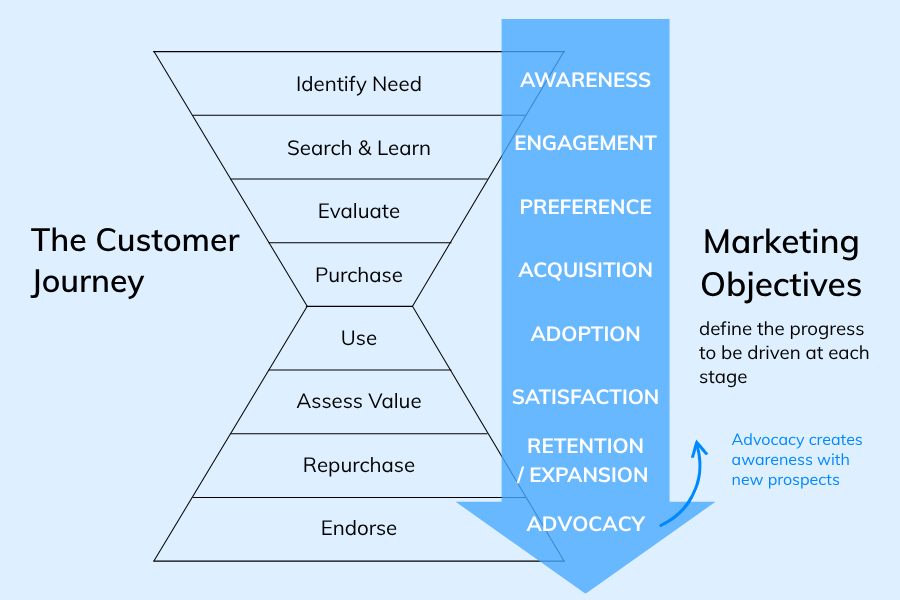
Marketing objectives translate the customer journey into the specific outcomes marketing needs to influence at each stage.
Rather than organizing the plan around channel objectives, cross-functional teams can focus on the progress they are trying to create: gaining attention, deepening interest, building preference, driving acquisition, helping customers adopt successfully, reinforcing satisfaction, strengthening retention and expansion, and ultimately earning advocacy.
That gives teams a shared set of priorities to plan against, helping keep channels, initiatives and messages aligned around the same target audience outcomes.
Explore our guide to audience strategy, including how to define your audiences, distinguish key audience groups and identify the roles people play in the decision-making process.
| Customer Journey Phase | Marketing Objective | Marketing's Job |
|---|---|---|
| Identify Need | Awareness | Earn attention and establish relevance |
| Search & Learn | Engagement | Educate and deepen interest |
| Evaluate | Preference | Build trust and demonstrate why your solution is the right fit |
| Purchase | Acquisition | Remove barriers and help the prospect act |
| Use | Adoption | Help customers use the product or service successfully |
| Assess Value | Satisfaction | Reinforce and demonstrate realized value |
| Repurchase | Retention / Expansion | Retain the relationship and grow it where appropriate |
| Endorse | Advocacy | Turn satisfied customers into active advocates |
The 8 marketing objectives:
1. Awareness
Awareness is about earning the attention of the right people and establishing relevance before they are actively evaluating your brand.
At this stage, someone may have identified a need or opportunity—or your marketing may help bring one to their attention.
They may be looking for entertainment, inspiration, information about trends, or insight into a problem they have not fully defined yet.
The goal is not necessarily to make an immediate sale. It is to become known and relevant enough to enter the person’s consideration set.
What the target audience needs
- Inspiration or entertainment
- Insight into trends or changes
- Help recognizing a problem or opportunity
- A compelling reason to pay attention
Your goal is to earn the attention of the right people and make your brand relevant enough to enter their consideration set.
2. Engagement
Engagement is about helping people understand a need, problem or opportunity and explore possible ways to address it.
At this stage they are often trying to learn more and asking: Is this relevant to me? How should I approach this? What are my options? This is where educational content becomes especially valuable.
Importantly, education at this point should not simply explain your product. It should help people understand the broader job to be done or problem they are trying to solve.
What the target audience needs
- Education and information
- Advice
- Help understanding available solutions
- Help comparing categories or approaches
- Customer stories that make the issue more tangible
Your goal is to deepen interest by helping people understand a problem or opportunity, and possible ways to address it.
3. Preference
Preference is about helping prospects decide that your brand, product or service is the best fit.
This is different from engagement. A prospect may learn a great deal from your brand without deciding that they should choose you.
At the Preference stage, people begin conducting more specific due diligence.
What prospects need
- Compare features and benefits
- See what existing customers think
- Understand what the experience will be like
- Evaluate credibility
- Compare alternatives
Your goal is to give prospects the proof and confidence they need to see your brand as the best fit.
4. Acquisition
Acquisition is about turning preference into action.
A prospect may have decided that your solution is the best fit and still not purchase. There may be another set of questions: Can I justify the cost? What outcome should I expect? Do I need someone else’s approval? Is now the right time? What risk am I taking?
That makes Acquisition distinct from Preference. Preference helps someone choose you. Acquisition helps them move forward.
What prospects need
- ROI or value models
- Customer stories
- Benchmarks
- Credentials
- Internal sell-in support
- Guarantees
- Reduced friction
- A legitimate reason to act now
Your goal is to remove the final barriers to purchase and make it easier for the prospect to act.
Purchase is not the end
of the customer journey
Many marketing plans devote most of their attention to the stages leading up to purchase.
But some of marketing’s greatest opportunities come afterward.
Once someone becomes a customer, marketing can help them:
- Successfully use what they purchased
- Realize the value they are receiving
- Stay and repurchase
- Expand the relationship
- Recommend the brand to others
That lower half of the journey can also strengthen the upper half.
Satisfied customers create reviews, testimonials, referrals and stories that help future prospects discover and choose the brand.
5. Adoption
Adoption is about helping new customers successfully begin using what they purchased.
If customers cannot get started, understand what to do next or experience early value, the sale itself has not solved the problem.
What customers need
- Onboarding
- Instructions
- Tutorials
- Training
- Product-use guidance
- Customer support
Your goal is to help customers get started successfully and begin realizing value as quickly as possible.
6. Satisfaction
Satisfaction is about helping customers recognize and evaluate the value they are receiving.
Delivering value and helping customers realize that value are not always the same thing.
Customers may need benchmarks, education, progress information or guidance that helps them understand whether the product or service is producing the expected result. Expectation-setting matters as well. If the expected result takes three months, but the customer expects it after two weeks, satisfaction can suffer even if the product ultimately performs exactly as intended.
What customers need
- Education and ongoing product guidance
- Product tips
- Community engagement
- Help evaluating results
- Reinforcement of benefits
- Opportunities to provide feedback
Your goal is to help customers recognize, evaluate and feel confident in the value they are receiving.
7. Retention / Expansion
Retention / Expansion is about keeping valuable customers and growing the relationship when doing so creates additional value for them.
Existing customers continually make decisions too.
They decide whether to:
- Renew
- Repurchase
- Stay
- Upgrade
- Try another product or service
- Move to a competitor
Marketing can support those decisions by continuing to demonstrate relevance and value rather than disappearing after the initial purchase.
What customers need
- Product updates
- Customer stories
- Renewal communications
- Upsell and cross-sell messages
- New use cases
- Loyalty programs
- Relevant companion products or services
Your goal is to keep the relationship relevant and valuable while creating appropriate opportunities to renew, repurchase, or expand.
8. Advocacy
Advocacy is about turning satisfied customers into active promoters of the brand.
Advocacy is the culmination of the journey. A customer has experienced enough value and confidence in the brand that they are willing to recommend it to someone else.
But advocacy should not be left to chance. Customers are not necessarily sitting around thinking: Should I write a review today? Should I volunteer for a case study? Should I recommend this company to someone?
Marketing can create the opportunity and make the ask.
What customers need
- Opportunities to share feedback about their experience
- To be asked to share a positive opinion or recommend the brand
- Easy ways to leave a review, provide a referral, or tell their story
- Shareable content they are compelled to pass along
- Exclusive access, recognition, or experiences worth talking about
Beyond delivering a remarkable customer experience, your goal is to identify satisfied customers, ask for their endorsement, and make it easy for them to share their experience with others.
How to prioritize your marketing objectives
Use the customer journey to identify where progress is breaking down, then prioritize the marketing objectives tied to the weakest stages.
When several areas need attention, work from the bottom of the journey up. That helps strengthen the experience for people already in the journey before investing more to bring additional people into it.
For example, if you are generating plenty of leads but few are converting, spending more on advertising will simply send more prospects into the same bottleneck. Improving Acquisition first will make the marketing you are already doing more productive.
Likewise, if satisfied customers are not being activated as advocates, strengthening Advocacy can generate referrals and credible customer proof that fuel Awareness, Engagement and Preference—ultimately helping drive more Acquisition.
Turn a journey-based marketing objective into a SMART objective
Awareness, Engagement, Preference, Acquisition, Adoption, Satisfaction, Retention / Expansion and Advocacy are journey-based marketing objectives. To make them actionable, translate them into SMART objectives.
SMART objectives are:
- Specific — clear about the audience and intended outcome
- Measurable — includes a defined measure or target
- Achievable — realistic given available resources and conditions
- Relevant — supports a meaningful business priority
- Time-bound — includes a defined timeframe
For example:
Awareness: Increase aided awareness among enterprise operations leaders in priority industries from 25% to 35% within 12 months.
Adoption: Increase adoption of three priority product capabilities among new customers from 50% to 70% within their first 90 days.
What comes after setting SMART objectives?
Once you know what marketing needs to accomplish, the next question is: What does the target audience, prospect or customer need at that point in the journey to help them move forward? That is where content and experience strategy begins.
For example:
- Someone in the Engagement stage may need education about the broader problem or available options.
- Someone in the Preference stage may need detailed product information, reviews and comparisons.
- Someone in the Adoption stage may need onboarding and tutorials.
- Someone in the Satisfaction stage may need help recognizing the value they are receiving.
Journey-based marketing objectives help identify where movement is needed. Understanding the customer’s needs at each phase helps determine what marketing should provide to create that movement.
Keep your marketing plan aligned to your objectives
Defining marketing objectives is only useful if they remain connected to the work marketing actually does.
Annum is unified marketing planning software that lets teams connect campaigns and individual tactics to the appropriate marketing objective, making it easier to see whether the work in market is aligned to the priorities you’ve established—and keep day-to-day execution connected to strategy.
See how Annum connects strategy to the marketing plan →
Frequently asked questions about marketing objectives
What is a marketing objective?
A marketing objective defines the progress marketing needs to drive with a target audience, prospect or customer in support of a broader business goal.
Examples include Awareness, Engagement, Preference, Acquisition, Adoption, Satisfaction, Retention / Expansion and Advocacy.
What are the eight marketing objectives?
The eight journey-based marketing objectives in this framework are Awareness, Engagement, Preference, Acquisition, Adoption, Satisfaction, Retention / Expansion and Advocacy.
They align to stages of the customer journey and define the progress marketing needs to drive to help people move forward.
What is the difference between a business objective and a marketing objective?
A business objective defines what the organization needs to achieve, such as revenue growth, profitability or market expansion.
A marketing objective defines the progress marketing needs to drive with the target audience or customers to help achieve that business objective.
What is the difference between a marketing objective and a KPI?
A marketing objective defines what marketing needs to accomplish. A KPI measures progress toward that objective.
For example, increasing Retention / Expansion may be the marketing objective, while renewal rate, repeat purchase rate or expansion revenue may be KPIs.
How are marketing objectives different from channel objectives?
Marketing objectives define the broader customer progress marketing needs to drive. Channel objectives define how individual channels contribute to that progress.
Email, social, content, paid media, events and other channels should support shared marketing objectives rather than operate toward disconnected priorities.
Should marketing objectives be SMART?
Yes. The eight journey-based marketing objectives provide the strategic focus, but the objective you put into your plan should be translated into a SMART objective.
SMART stands for Specific, Measurable, Achievable, Relevant and Time-bound. A SMART objective defines the audience, intended outcome, measure or target, relevance to the business and timeframe.
How do you prioritize marketing objectives?
Start by identifying the weak links in the customer journey and prioritize the marketing objectives associated with those stages.
When several areas need improvement, evaluate the journey from the bottom up so you strengthen downstream performance before investing more to bring additional people into the journey.
Why is advocacy an important marketing objective?
Advocacy turns satisfied customers into a powerful source of referrals and credible customer proof.
By identifying satisfied customers, asking for their endorsement and making it easy to share their experience, marketers can strengthen Awareness, Engagement and Preference—and ultimately help drive more Acquisition.
This customer-centric marketing objectives framework was developed by Patty Radford Henderson, Founder & CEO of Annum, drawing on more than 30 years of experience in marketing strategy and planning. She teaches the framework in workshops and conference sessions.